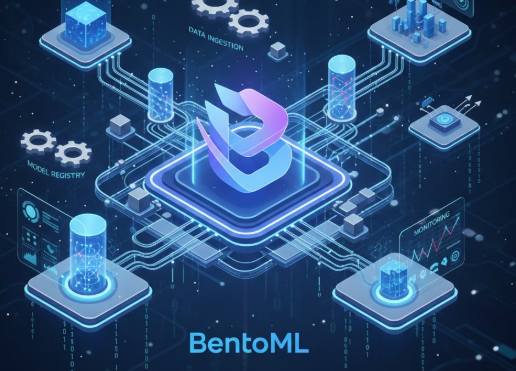
Introduction to BentoML
In the rapidly evolving landscape of Machine Learning (ML), the journey from model development to production deployment is often fraught with challenges. The complexities of packaging models, managing dependencies, ensuring scalability, and monitoring performance can significantly impede the time-to-market for AI-powered applications. This is where BentoML emerges as a game-changer. BentoML is an open-source framework designed to streamline the entire MLOps lifecycle, enabling data scientists and engineers to build, package, and deploy ML models with ease and efficiency.
This comprehensive guide delves into the core concepts, features, and benefits of BentoML, providing a deep dive into how it can revolutionize your MLOps workflows and accelerate the delivery of production-ready AI solutions.
Understanding the MLOps Challenge
Before exploring BentoML in detail, it’s crucial to understand the pain points it addresses. Traditional ML development often involves a fragmented process, where data scientists focus on model training and validation, while operations teams handle deployment and infrastructure management. This handoff can lead to several issues:
- Dependency Hell: ML models often rely on specific versions of libraries and frameworks. Managing these dependencies across different environments can be a nightmare.
- Packaging Complexity: Packaging a model and its dependencies into a deployable artifact can be a tedious and error-prone process.
- Scalability Issues: Ensuring that a model can handle increasing traffic and maintain performance under load requires careful planning and infrastructure management.
- Monitoring Difficulties: Tracking model performance, identifying anomalies, and retraining models based on real-world data are essential for maintaining accuracy and reliability.
These challenges highlight the need for a unified and automated MLOps platform that simplifies the entire ML lifecycle.
BentoML: A Comprehensive MLOps Framework
BentoML addresses the challenges outlined above by providing a comprehensive framework for building, packaging, and deploying ML models. It offers a range of features designed to simplify the MLOps process, including:
- Model Packaging: BentoML allows you to package your ML model, its dependencies, and custom code into a self-contained artifact called a “Bento.” This Bento can be easily deployed to various platforms, including Docker, Kubernetes, and cloud services.
- API Server Generation: BentoML automatically generates a REST API for your model, allowing you to easily integrate it with other applications.
- Scalability and Performance: BentoML supports horizontal scaling and provides tools for optimizing model performance.
- Monitoring and Observability: BentoML integrates with popular monitoring tools, allowing you to track model performance and identify potential issues.
- Reproducibility: BentoML ensures that your models are reproducible by tracking the dependencies and configurations used to train them.
Key Concepts in BentoML
To effectively utilize BentoML, it’s essential to understand its core concepts:
Bento
A Bento is the fundamental unit of deployment in BentoML. It’s a self-contained package that includes your ML model, its dependencies, and any custom code required for serving. Think of it as a Docker container specifically designed for ML models.
Service
A Service defines how your model will be served. It specifies the API endpoints, input/output formats, and any pre- or post-processing logic. A Service is defined using Python code and leverages BentoML’s built-in components.
Runner
A Runner is a component responsible for executing your ML model. It can be a simple function call or a more complex execution graph involving multiple models or data processing steps. Runners provide a flexible way to define how your model is used within a Service.
Yatai
Yatai is the BentoML deployment platform. It’s a centralized repository for storing and managing Bentos. Yatai provides a web UI for managing deployments, monitoring performance, and scaling your services.
A Practical Example: Deploying a Scikit-learn Model with BentoML
Let’s walk through a simple example of deploying a Scikit-learn model using BentoML. This example will demonstrate how to package a model, define a service, and deploy it using BentoML.
Step 1: Train and Save the Model
First, we need to train a Scikit-learn model and save it to a file:
from sklearn.linear_model import LogisticRegression
from sklearn.datasets import load_iris
import bentoml

# Load the Iris dataset
iris = load_iris()
X, y = iris.data, iris.target

# Train a Logistic Regression model
model = LogisticRegression(solver='liblinear', multi_class='auto')
model.fit(X, y)

# Save the model using BentoML
bentoml.sklearn.save_model(
 "iris_classifier",
 model,
 signatures={"predict": {"batchable": True, "input_types": [bentoml.np_ndarray()], "output_types": [bentoml.np_ndarray()]}},
)
Step 2: Define the Service
Next, we need to define a Service that will serve our model. This Service will define the API endpoint and the logic for processing incoming requests:
import bentoml
from bentoml.io import JSON
from bentoml.io import NumpyNdarray

iris_classifier_runner = bentoml.sklearn.get("iris_classifier:latest").to_runner()

svc = bentoml.Service("iris_classifier_service", runners=[iris_classifier_runner])

@svc.api(input=NumpyNdarray(), output=JSON())
def classify(input_data):
 return iris_classifier_runner.predict.run(input_data)
Step 3: Build the Bento
Now, we can build the Bento by running the following command in the same directory as your `service.py` file:
bentoctl build
Step 4: Deploy the Bento
Finally, we can deploy the Bento to a platform of our choice. BentoML supports various deployment options, including Docker, Kubernetes, and cloud services. For example, to deploy to Docker, you can use the following command:
bentoctl deploy iris_classifier_service:latest --platform docker
Benefits of Using BentoML
BentoML offers numerous benefits for organizations looking to streamline their MLOps workflows:
- Simplified Deployment: BentoML simplifies the deployment process by providing a unified framework for packaging and deploying models.
- Increased Efficiency: BentoML automates many of the manual tasks involved in MLOps, freeing up data scientists and engineers to focus on more strategic initiatives.
- Improved Scalability: BentoML supports horizontal scaling, allowing you to easily scale your models to handle increasing traffic.
- Enhanced Observability: BentoML integrates with popular monitoring tools, providing insights into model performance and enabling proactive issue resolution.
- Reduced Costs: By streamlining the MLOps process, BentoML can help organizations reduce costs associated with infrastructure, maintenance, and development.
BentoML vs. Other MLOps Tools
While several MLOps tools are available, BentoML distinguishes itself through its focus on simplicity, flexibility, and comprehensive features. Compared to other tools, BentoML offers a more streamlined workflow for packaging and deploying models, while also providing robust support for scalability and monitoring.
Here’s a brief comparison with some popular alternatives:
- MLflow: MLflow primarily focuses on experiment tracking and model management. While it offers some deployment capabilities, it’s not as comprehensive as BentoML in terms of packaging and serving.
- Seldon Core: Seldon Core is a powerful platform for deploying ML models on Kubernetes. However, it can be more complex to set up and configure than BentoML.
- Kubeflow: Kubeflow is a comprehensive MLOps platform built on Kubernetes. While it offers a wide range of features, it can be overwhelming for smaller teams or projects.
BentoML strikes a balance between simplicity and functionality, making it a suitable choice for organizations of all sizes.
Conclusion
BentoML is a powerful and versatile framework that can significantly streamline your MLOps workflows. By providing a unified platform for building, packaging, and deploying ML models, BentoML empowers data scientists and engineers to deliver production-ready AI solutions with ease and efficiency. Whether you’re a small startup or a large enterprise, BentoML can help you accelerate your AI initiatives and unlock the full potential of your ML models.
As the field of MLOps continues to evolve, BentoML remains at the forefront, providing innovative solutions to address the challenges of deploying and managing ML models in production. By embracing BentoML, you can future-proof your MLOps infrastructure and ensure that your AI applications are scalable, reliable, and maintainable.