
In the fast-paced digital world of 2026, your website is no longer just a static brochure; it is a living, breathing ecosystem that requires the right engine to run. Whether you are a solo developer or a CTO at a Fortune 500 company, the Content Management Tools you choose today will determine how fast you can scale, how secure your data stays, and how effectively you can reach your audience across the decentralized web. If you are still using outdated systems, you aren’t just falling behind—you are becoming invisible.
Key Takeaways
- AI Integration is Standard: In 2026, the best Content Management Tools have native AI for SEO, translation, and automated tagging.
- Headless is King: Decoupled architectures allow for multi-channel publishing across web, mobile, and even AR/VR interfaces.
- Security First: With rising cyber threats, enterprise-grade security and content governance are non-negotiable features.
- User Experience (UX) Matters: The “no-code” revolution has made high-end website creation tools accessible to non-technical team members.
The Evolution of Content Management Tools in 2026
The landscape of Content Management Tools has shifted dramatically over the last few years. We have moved away from “one-size-fits-all” platforms toward specialized, modular ecosystems. I have seen many companies struggle because they chose a platform based on popularity rather than their specific technical needs.
Today, digital content management is about more than just hitting “publish.” It involves managing a content workflow that includes digital asset management (DAM), real-time collaboration, and content personalization. The best CMS platforms of 2026 are those that stay out of the way of the creators while providing robust power to the developers.
“The true value of a modern CMS isn’t just in storing text; it’s in the ability to orchestrate experiences across every possible digital touchpoint.” — Industry Analyst Perspective, 2026 [1].
Popular CMS Platforms Categorized
To help you navigate this crowded market, let’s look at the leading categories of Content Management Tools currently dominating the industry:
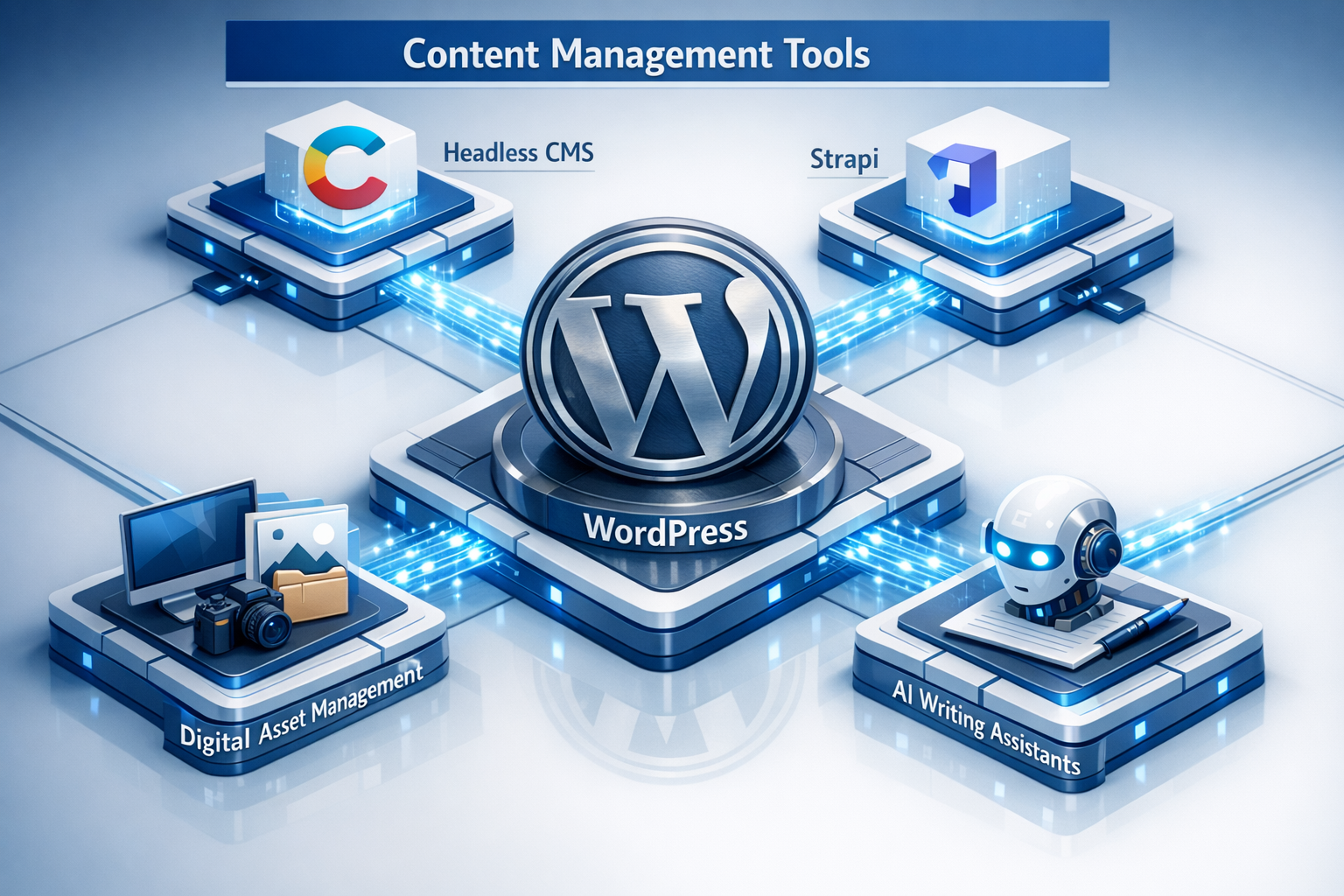
- Traditional/Monolithic: WordPress remains the giant here, but it has evolved with deeply integrated “Full Site Editing” (FSE) capabilities.
- Headless CMS: Tools like Contentful, Strapi, and Sanity are the go-to for multi-channel publishing.
- Website Builders: Squarespace and Wix have integrated advanced website builder software features that rival professional IDEs.
- Enterprise Solutions: Adobe Experience Manager (AEM) and Sitecore continue to lead for massive organizations requiring intense content governance.
Enterprise vs. Small Business CMS Options: Finding Your Fit
When selecting Content Management Tools, the “best” choice depends entirely on your scale. A tool that works for a boutique design agency will likely fail at the enterprise level due to lack of permissioning and scalability.
Comparison Matrix: Small Business vs. Enterprise
| Feature | Small Business CMS | Enterprise CMS |
|---|---|---|
| Primary Goal | Ease of use & Speed | Security & Scalability |
| Typical Tools | WordPress, Webflow, Wix | Contentful, Adobe Experience Manager |
| Implementation | Days to Weeks | Months |
| Learning Curve | Low (Intuitive) | High (Requires Training) |
| Price Point | $20 – $200 / month | $5,000+ / month |
| AI Features | Basic (Writing prompts) | Advanced (Predictive Analytics) |
For Small Businesses
If you are running a small team, you need website creation tools that don’t require a full-time DevOps engineer. WordPress alternatives like Webflow have gained massive traction in 2026 because they offer “pixel-perfect” design control without the bloat of traditional plugins.
For Enterprises
For larger organizations, enterprise content management focuses on “Single Source of Truth.” You need a system where a single product description change automatically updates your website, your mobile app, and your third-party retail partners simultaneously. This is where digital content management becomes a competitive advantage.
AI-Powered Content Management Features You Can’t Ignore
We cannot talk about Content Management Tools in 2026 without mentioning Artificial Intelligence. It is no longer a gimmick; it is the backbone of the editorial tools we use daily.
Key AI Features in Modern CMS:
- Auto-Tagging & Metadata: AI automatically analyzes images and videos to apply SEO-friendly alt-text and categories.
- Dynamic Content Personalization: The CMS changes what a user sees in real-time based on their past behavior [2].
- Automated Content Refactoring: Need to turn a long blog post into a series of social media snippets? Modern content creation tools do this with one click.
- Predictive Performance: AI tells you which headlines are likely to perform best before you even publish.
I personally find that the most useful AI integration is multi-channel publishing optimization. The system automatically adjusts formatting for different devices, ensuring your web content strategy stays consistent everywhere.
The Rise of Headless CMS Architectures
For the tech enthusiasts among us, the transition to Headless CMS has been the biggest story of the decade. Unlike a traditional CMS, a headless system separates the “body” (the content) from the “head” (the presentation layer).
Why Headless is the Future:
- Framework Agnostic: You can use React, Vue, Next.js, or even Svelte to build your frontend.
- Security: Since the frontend is decoupled, your database is much harder to target via standard web exploits.
- Future-Proofing: If you want to redesign your website in 2028, you don’t have to migrate your content. You just build a new “head” and plug it into your existing Content Management Tools.
Top Headless Content Management Tools:
- Contentful: Known for its world-class API and developer experience.
- Strapi: The leading open-source headless option for those who want full control.
- Sanity.io: Exceptional for real-time collaborative content creation.
Security, Governance, and Integration Capabilities
In 2026, a leak of sensitive customer data can end a business. Therefore, content management systems must prioritize content governance. This includes:
- Role-Based Access Control (RBAC): Granular permissions to ensure only the right people can publish.
- Audit Logs: Keeping track of every single change made to the site.
- SSO Integration: Seamless login via Okta or Google Workspace to prevent unauthorized access.
The Integration Ecosystem
Your Content Management Tools should not live on an island. They must integrate with your entire marketing stack. I recommend looking for tools that offer native integrations with:
- CRM Software: (Salesforce, HubSpot) to track how content leads to sales.
- Marketing Automation: To trigger emails based on content interaction.
- Digital Asset Management (DAM): For hosting high-resolution video and 3D assets.
How to Choose the Right Content Management Tools for 2026
Choosing a CMS is a long-term commitment. Moving platforms is expensive and risky. To get it right, follow this checklist:
- Define Your Use Case: Are you building a simple blog, an e-commerce powerhouse, or a multi-lingual news portal?
- Evaluate the Learning Curve: Does your marketing team need a developer to make a simple text change? If so, the tool might be too complex.
- Check the Mobile Experience: Mobile content management capabilities are vital. Can you edit an emergency update from your phone?
- Analyze the Total Cost of Ownership (TCO): Don’t just look at the monthly fee. Factor in developer hours, hosting, and third-party plugin costs.
- Test the Support: When things go wrong at 2 AM, will there be a human to help you?
Expert Recommendation
If you are a growing tech startup, I highly recommend starting with a Headless CMS like Strapi or a high-end website builder like Webflow. They offer the best balance of speed and future-scalability. For hobbyists, WordPress alternatives like Ghost provide a much cleaner, faster writing experience.
Conclusion: The Future of Web Publishing Platforms
The world of Content Management Tools in 2026 is defined by flexibility, intelligence, and speed. Whether you lean toward the simplicity of a website builder or the raw power of a headless architecture, the goal remains the same: delivering value to your users as efficiently as possible.
As we look forward, the integration of content personalization and AI will only deepen. The winners of the digital age will be those who treat their CMS not just as a tool, but as a strategic asset.
Actionable Next Steps:
- Audit your current CMS for mobile performance and AI readiness.
- Map out your web content strategy for the next 18 months.
- Trial at least two different Content Management Tools from the list above to compare the user experience.

